Deepbrain AI Review What Businesses Should Know Before Adopting It

Artificial intelligence has moved from experimentation to practical business infrastructure. Organizations across the United States, United Kingdom, Canada, and Australia are investing in tools that automate content creation, reduce production costs, and scale digital communication. In this environment, deepbrain ai has emerged as a serious contender in the AI video generation space.
Deepbrain ai is designed to help businesses create professional quality video content using artificial intelligence. Instead of hiring production teams, renting studios, and managing complex editing workflows, users can generate videos from scripts within minutes. For marketing teams, educators, HR departments, and enterprise communications leaders, this represents a significant shift in how video is produced and distributed.
The problem deepbrain ai addresses is simple but costly. Traditional video production is time intensive, expensive, and difficult to scale. Businesses need faster content cycles and consistent messaging across global audiences. Deepbrain ai aims to solve that by automating the heavy lifting while maintaining professional output quality.
This review explains what the platform does, how it works, and whether it is a smart investment for modern organizations.
What Is Deepbrain AI
4
Deepbrain AI is an AI powered video generation platform that converts text into realistic video presentations. The platform allows users to create AI avatar videos, training materials, marketing explainers, and educational content without advanced editing skills.
The company behind deepbrain ai positions itself within the broader AI video and synthetic media market. It competes with other text to video platforms but differentiates itself through realistic avatars, multilingual capabilities, and enterprise level scalability.
Within the broader SaaS and EdTech landscape, deepbrain ai sits at the intersection of artificial intelligence, content marketing, corporate training, and digital transformation. As businesses increasingly rely on video for customer engagement and internal communication, platforms like deepbrain ai are becoming strategic tools rather than experimental add ons.
For new readers, it is important to understand that this is not a traditional video editing suite. It is an AI automation tool that focuses on speed, accessibility, and scalability.
How Deepbrain AI Works
Understanding the workflow helps reduce uncertainty around adoption. The platform follows a relatively straightforward process.
Step One Create An Account And Select A Template
Users begin by registering and selecting a video template. Templates are categorized by use case such as marketing, onboarding, product demo, or education.
Step Two Input Your Script
The user enters a script directly into the editor. This script becomes the foundation of the video. The AI processes the text and prepares it for voice and avatar rendering.
Step Three Choose An AI Avatar And Voice
Deepbrain ai offers digital avatars that act as presenters. Users can select from various personas, languages, and voice tones. This step allows customization for brand voice and audience demographics.
Step Four Customize Visual Elements
Users can add background visuals, slides, logos, and branding elements. This ensures the final video aligns with company guidelines.
Step Five Generate And Export
Once finalized, the AI renders the video. Export options allow sharing across marketing channels, learning platforms, or internal systems.
Daily usage typically involves script updates, batch video production, and minor edits rather than complex design tasks. This simplicity lowers the barrier to adoption for non technical teams.
Core Features Overview
Deepbrain ai includes several core capabilities that drive its value.
AI Avatar Video Generation
The platform transforms text into videos featuring realistic AI presenters. This eliminates the need for camera equipment or on screen talent. For global organizations, avatars provide consistent messaging across regions.
Multilingual Support
Deepbrain ai supports multiple languages and voice options. This matters for companies operating in international markets who need localized content without duplicating production costs.
Custom Branding And Templates
Businesses can integrate logos, brand colors, and custom layouts. This ensures professional consistency and reduces manual formatting work.
Script To Video Automation
The central feature is text to video automation. By converting scripts into ready to publish videos, deepbrain ai significantly reduces turnaround time.
Each of these features addresses a real business challenge. Together, they create a streamlined production pipeline.
Key Benefits For Users
Features alone do not justify investment. Practical benefits matter more.
Significant Time Savings
Marketing and training teams can create videos in hours instead of weeks. This accelerates campaign launches and onboarding programs.
Cost Efficiency
By reducing reliance on external production agencies, organizations can lower recurring content expenses.
Improved Content Scalability
Deepbrain ai enables batch production of videos for different departments, regions, or product lines.
Ease Of Use
The interface is designed for non technical users. This reduces training time and improves internal adoption rates.
Consistent Brand Messaging
AI avatars and templates ensure uniform tone and presentation quality across content assets.
These benefits directly impact productivity and operational efficiency, which are critical for Tier One markets where labor costs are high.
Who Should Use This Software
Deepbrain ai is not limited to a single industry. However, certain user groups benefit more than others.
Marketing teams that produce regular video campaigns will find strong value. HR departments creating onboarding materials can automate repetitive content. Educational institutions and EdTech companies can scale lecture style videos. Corporate training departments can generate standardized modules.
Small to mid sized businesses that lack dedicated video production teams are ideal candidates. Larger enterprises seeking scalable video automation across global operations can also leverage the platform effectively.
If your organization frequently relies on video but struggles with time or cost constraints, deepbrain ai deserves consideration.
Use Cases And Real World Scenarios
Practical examples help clarify value.
A software company launching a new product can use deepbrain ai to create product explainer videos for website landing pages. Instead of filming executives, the marketing team writes a script and generates a professional video within the platform.
A multinational corporation can produce compliance training videos in multiple languages using AI avatars. This ensures consistent policy communication across offices in North America, Europe, and Australia.
An online education provider can convert written course modules into video lessons. This enhances engagement without hiring presenters.
These scenarios demonstrate both daily operational use and long term strategic impact.
User Experience And Interface
User experience often determines whether a SaaS platform succeeds internally.
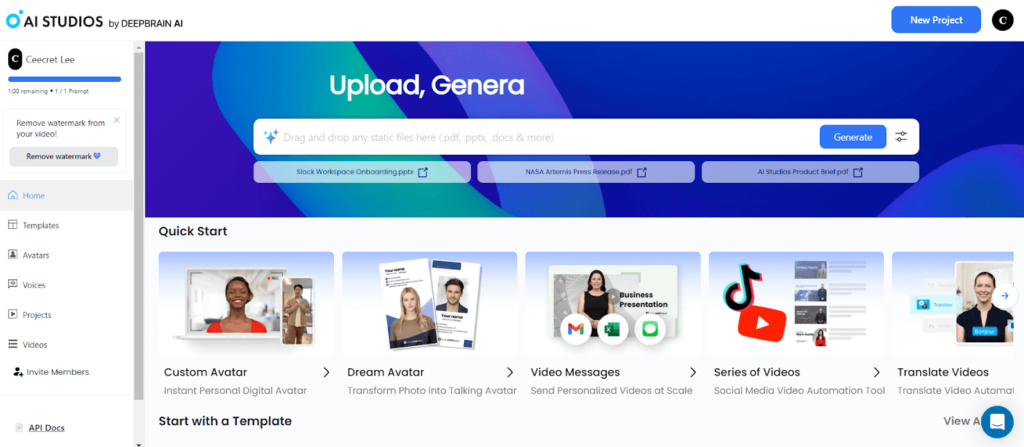
Deepbrain ai features a clean, structured dashboard. Navigation is intuitive, with clearly labeled sections for templates, scripts, avatars, and exports. The learning curve is moderate but manageable. Most users can create their first video after a short onboarding session.
Design quality appears modern and functional rather than overly complex. Accessibility features such as subtitle support improve usability for diverse audiences.
For decision makers, ease of navigation translates into faster team adoption and lower support requests.
Pricing And Plans Overview
Deepbrain ai offers tiered pricing plans that vary based on usage limits, video length, and advanced features. Typically, there is a distinction between entry level plans for individual creators and higher tier plans for businesses requiring more production capacity.
Free trials or limited free options may allow potential users to test functionality before committing. Paid plans unlock extended rendering time, additional avatars, and enhanced customization.
From a value perspective, organizations should compare subscription costs against traditional video production expenses. In many cases, the return on investment becomes clear when evaluating labor and outsourcing savings.
Pros And Cons
An honest evaluation requires balance.
Pros
High quality AI avatars
Fast video generation workflow
Multilingual capabilities
Scalable for teams
Reduced production costs
Cons
Output may lack the emotional nuance of live presenters
Customization depth may not match advanced video editing software
Subscription costs can increase with heavy usage
For many businesses, the advantages outweigh the limitations. However, companies seeking cinematic storytelling may still prefer traditional production methods.
Comparison With Similar Tools
Deepbrain ai competes in a growing AI video landscape. Comparable platforms offer similar text to video functionality, but differences often appear in avatar realism, language support, and pricing structure.
Some alternatives focus heavily on marketing content, while others prioritize educational use cases. Deepbrain ai positions itself as a versatile solution across multiple industries.
In scenarios where hyper realistic avatars or deep enterprise integrations are required, organizations may compare feature sets carefully. In cases where simplicity and speed are priorities, deepbrain ai performs strongly.
Comparison research is especially important for buyers in the United States, United Kingdom, Canada, and Australia, where procurement processes often require documented evaluations.
Buying Considerations For Decision Makers
Decision makers should evaluate several factors before adoption.
Budget Allocation
Compare subscription costs against projected savings in production and labor.
Team Adoption
Assess whether marketing, HR, or training teams are prepared to integrate AI driven workflows.
Integration Requirements
Determine whether the platform integrates with learning management systems, marketing automation tools, or internal communication platforms.
Long Term Scalability
Consider whether deepbrain ai can handle growing content demands as your organization expands.
SaaS review case studies often highlight measurable outcomes such as reduced production time and increased engagement. These metrics provide helpful benchmarks during evaluation.
Security Privacy And Compliance
Enterprise buyers prioritize data protection. Deepbrain ai processes user scripts and content within its platform, making privacy safeguards essential.
Organizations should review data handling policies, storage practices, and compliance standards relevant to their region. Businesses operating in jurisdictions with strict privacy regulations must confirm that the platform aligns with internal compliance requirements.
Transparent security documentation builds trust and reduces procurement friction.
Support And Documentation
Reliable customer support enhances long term satisfaction.
Deepbrain ai typically offers knowledge bases, tutorials, and documentation to guide users through setup and troubleshooting. Support channels may include email assistance and ticket systems.
Response times and support quality play a crucial role for enterprise users who depend on consistent output for marketing or training campaigns.
Well structured documentation reduces onboarding friction and improves user confidence.
Final Verdict
Deepbrain ai represents a practical solution for organizations seeking scalable AI video generation. It simplifies content production, lowers costs, and accelerates communication workflows.
The platform is best suited for marketing teams, corporate training departments, EdTech providers, and businesses operating across multiple regions. Companies that prioritize speed, consistency, and multilingual support will find strong value.
Organizations requiring highly cinematic or emotionally nuanced storytelling may still prefer traditional video production methods. However, for most business communication needs, deepbrain ai delivers measurable efficiency gains.
For decision makers in Tier One markets, the platform offers a compelling balance between automation, scalability, and usability.
Frequently Asked Questions
Is Deepbrain AI Easy To Use For Non Technical Teams
Yes. The interface is designed for accessibility. Most users can generate videos without advanced editing skills.
Can Deepbrain AI Scale For Large Enterprises
The platform supports higher tier plans that accommodate larger production volumes and team collaboration needs.
Does Deepbrain AI Support Multiple Languages
Yes. Multilingual capabilities allow organizations to create localized content efficiently.
Is Deepbrain AI Suitable For Educational Use
Yes. Educational institutions and training providers can convert written material into engaging video lessons.
How Does Deepbrain AI Compare To Traditional Video Production
Deepbrain ai offers faster turnaround and lower costs. Traditional production may provide higher emotional nuance but requires more resources.